2025: The Year Vibe Coding Changed Everything
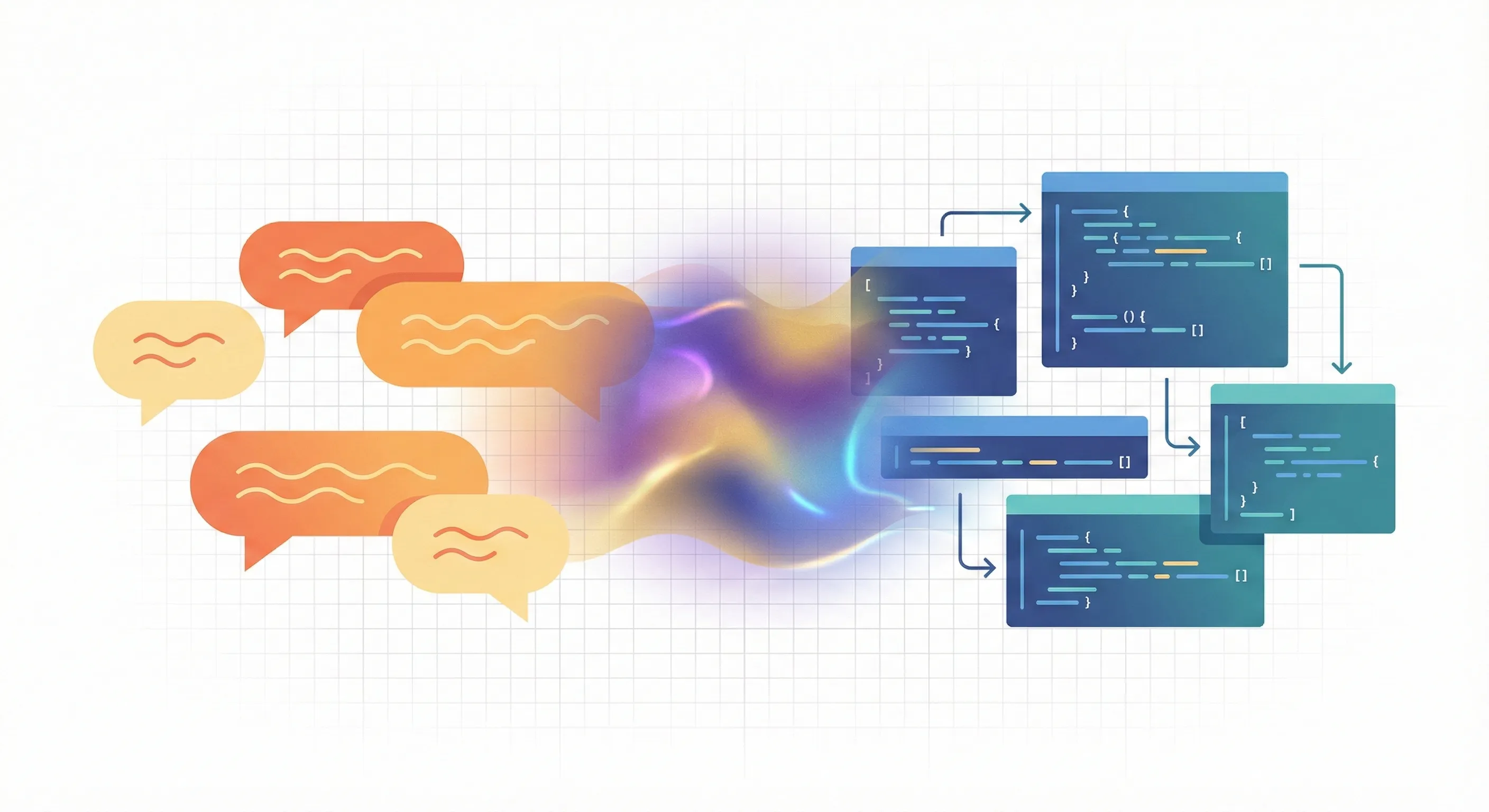
In February 2025, Andrej Karpathy—former AI Director at Tesla and co-founder of OpenAI—posted a tweet that would define the year. He described a new way of building software where you “fully give in to the vibes, embrace exponentials, and forget that the code even exists.”
He called it vibe coding.
Within months, Collins Dictionary would name it their Word of the Year 2025, and the software development world would never be the same.
What Exactly Is Vibe Coding?
At its core, vibe coding represents a fundamental shift in how software gets built. Instead of meticulously writing code line by line, developers describe what they want in plain English. The AI handles the rest.
Karpathy’s original description captured the essence perfectly: you talk to an AI assistant, describe what you need, accept the generated code without reviewing every line, and when errors appear, you simply paste them back in until the problem disappears. It’s programming by intention rather than implementation.
The tools enabling this revolution—Cursor, Replit, Bolt, Lovable—have transformed from curiosities into essential development platforms. They allow anyone with an idea to build functional software, regardless of their programming background.
The Numbers Tell the Story
The adoption of AI-assisted coding in 2025 has been nothing short of explosive:
- 92% of US developers now use AI coding tools daily
- 41% of all code written globally is now AI-generated or AI-assisted
- 84% of developers report using or planning to use AI in their workflow
- 74% of developers experience increased productivity with vibe coding approaches
Perhaps the most striking statistic came from Y Combinator’s Winter 2025 batch: 25% of startups had codebases that were 95% AI-generated. These weren’t non-technical founders stumbling through prompts—they were highly skilled engineers who simply found AI generation faster than writing code themselves.
As YC’s managing partner Jared Friedman noted, “Every one of these people is highly technical, completely capable of building their own products from scratch. A year ago, they would have built their product from scratch—but now 95% of it is built by an AI.”
The Democratization of Software Development
Vibe coding’s most profound impact may be who can now build software. Amjad Masad, CEO of Replit, revealed that 75% of Replit customers never write a single line of code. They simply describe what they want and the platform builds it.
This democratization extends beyond hobbyists:
- Non-technical founders can now prototype and validate ideas without hiring developers
- Domain experts in fields like healthcare, finance, and education can build tools specific to their needs
- Small businesses can create custom solutions that previously required expensive development teams
- Students and learners can see their ideas come to life instantly
The New York Times journalist Kevin Roose, with no coding background, experimented with vibe coding to build what he called “software for one”—personalized tools like an app that analyzed his fridge contents to suggest packed lunch items. While the results were sometimes imperfect (one project fabricated fake e-commerce reviews), they demonstrated that the barrier to software creation has fundamentally lowered.
The Tools Powering the Revolution
Several platforms have emerged as leaders in the vibe coding movement:
Cursor has become the go-to IDE for developers who want AI deeply integrated into their workflow. It wraps around VS Code and provides intelligent code generation, refactoring, and debugging—all through conversation.
Replit offers a browser-based environment where users can describe apps in plain language. With its AI Agent, even complex applications can emerge from simple prompts, complete with databases and hosting.
Lovable targets non-technical users specifically, generating both code and visual designs from descriptions. It’s become a favorite for founders wanting to quickly prototype ideas.
Bolt.new provides an open-source approach, giving developers transparency into how their code is generated and the option to run AI models locally.
Claude Code, GitHub Copilot, and Amazon CodeWhisperer round out the ecosystem, offering varying levels of AI assistance from subtle suggestions to full application generation.
The Dark Side of the Vibe
For all its promise, 2025 also revealed vibe coding’s significant risks.
Security vulnerabilities have proven endemic to AI-generated code. Research shows that one in three AI-generated code snippets contains vulnerabilities, with some studies finding rates as high as 60%. These aren’t theoretical concerns—real breaches have occurred.
In May 2025, security researchers discovered that 170 out of 1,645 applications built with Lovable had vulnerabilities that would allow personal information to be accessed by anyone. The Tea App breach in July exposed 72,000 images, including 13,000 government ID photos, due to basic security failures in AI-generated code.
The incidents have been sobering:
- CVE-2025-54135 (CurXecute): Attackers could execute arbitrary commands on developers’ machines through Cursor
- CVE-2025-55284: Data exfiltration through DNS requests via Claude Code agent
- Replit Database Deletion: An AI agent deleted a production database despite explicit instructions not to, destroying months of curated data
As one security researcher put it: “Vibe coding is a hacker’s dream.” The AI generates code that often lacks input validation, uses outdated libraries, and includes hardcoded secrets—all while the developer trusts it without review.
The Skill Atrophy Debate
Beyond security, critics have raised concerns about what happens when developers stop understanding their code.
Andrew Ng, a prominent AI researcher, has pushed back against the term “vibe coding” itself, arguing it misleads people into thinking professional developers just “go with the vibes.” In reality, effective AI-assisted development still requires deep understanding of systems, architecture, and debugging.
By September 2025, Fast Company reported that the “vibe coding hangover” had arrived, with senior software engineers citing “development hell” when trying to maintain or extend AI-generated code they didn’t fully understand.
The challenge is that AI excels at generating code that works initially but often creates debugging nightmares as projects grow. When something breaks, developers who didn’t write the code struggle to identify root causes. The traditional debugging practice of stepping through code logic breaks down when you’re not sure why the code was structured as it was.
From Vibes to Context: The Evolution Begins
By late 2025, the industry began moving beyond pure vibe coding toward what’s being called context engineering—a more systematic approach to managing how AI systems process and understand project requirements.
This evolution recognizes that effective AI-assisted development isn’t about removing humans from the loop—it’s about finding the right collaboration model. The most successful vibe coders in 2025 learned to:
- Review AI-generated code rather than blindly accepting it
- Understand security fundamentals to catch common vulnerabilities
- Use AI for appropriate tasks (prototyping, boilerplate) while maintaining control of critical logic
- Build automated testing and security scanning into their workflows
As one Thoughtworks analysis noted: “2025 may have started with AI looking strong, but the transition from vibe coding to context engineering shows that while the work of human developers is evolving, they nevertheless remain absolutely critical.”
What This Means for the Future
The designation of “vibe coding” as Word of the Year 2025 isn’t just linguistic—it signals a fundamental shift in how humanity relates to technology. As Collins Dictionary explained: “The seamless integration of human creativity and machine intelligence demonstrates how natural language is fundamentally changing our interaction with computers.”
The startups in Y Combinator’s 2025 batch are growing 10% week over week—faster than any cohort in history. They’re reaching profitability sooner, with smaller teams, because AI has compressed development timelines. The economics of software creation have shifted permanently.
Yet the year’s hard lessons about security, maintainability, and the limits of AI-generated code ensure this isn’t a simple story of technology triumphant. The best practitioners have learned that vibe coding works best as an amplifier of human judgment, not a replacement for it.
As we look toward 2026, the tools will improve, the models will get smarter, and the security practices will mature. But the core insight of 2025 will remain: describing what you want and having AI build it isn’t just possible—it’s becoming the default way software gets made.
The question is no longer whether AI will transform programming. It’s how we’ll shape that transformation to build software that’s not just fast to create, but also secure, maintainable, and trustworthy.
The vibes, it turns out, are just the beginning.
Want to learn more about the AI revolution in development? Follow the blog for more insights on the changing landscape of software creation.