The Security Crisis Nobody's Ready For: What Vibe Coding Will Unleash in 2026
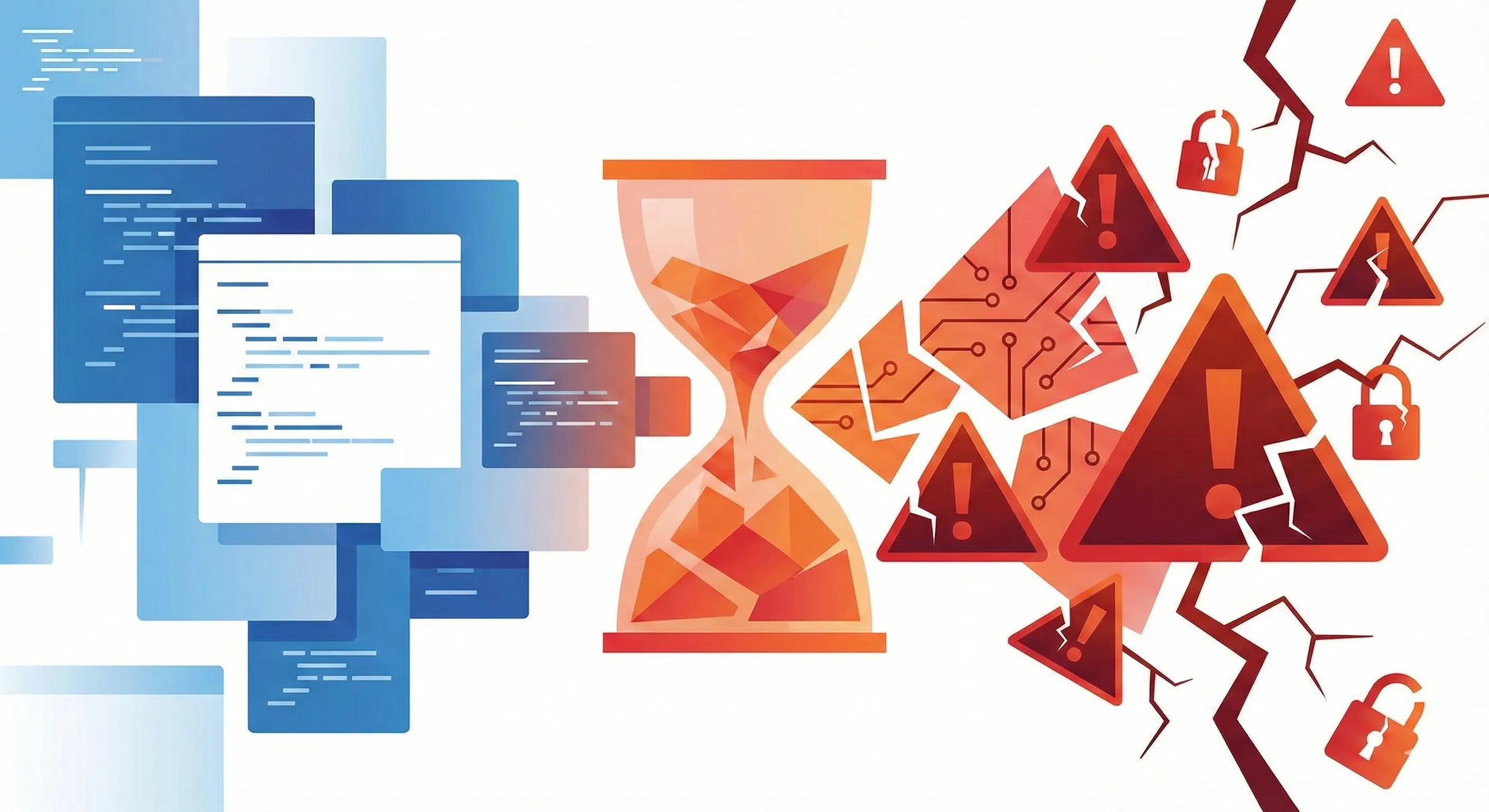
2025 was the year vibe coding went mainstream. Developers described what they wanted, AI wrote the code, and products shipped at unprecedented speed. Collins Dictionary named it Word of the Year. Y Combinator celebrated startups with 95% AI-generated codebases.
But beneath the celebration, a crisis was building.
Now, as we enter 2026, security researchers, threat intelligence teams, and incident responders are sounding alarms that most of the industry isn’t ready to hear: the vibe coding revolution has created the largest attack surface in the history of software development.
This isn’t speculation. The data is already here.
The Numbers That Should Terrify You
Let’s start with what we know from 2025:
- 45% of AI-generated code contains security vulnerabilities aligned with the OWASP Top 10
- 62% of AI-generated code solutions contain design flaws or known security vulnerabilities
- 72% failure rate in Java—the language powering enterprise applications worldwide
- 86% of code samples failed to defend against cross-site scripting (XSS)
- 88% of code samples were vulnerable to log injection attacks
These aren’t edge cases. These are systematic failures baked into how AI generates code. And the models aren’t getting better at security—even as they improve at writing syntactically correct code.
As Veracode’s research revealed: “Models are getting better at coding accurately but are not improving at security. Larger models do not perform significantly better than smaller models, suggesting this is a systemic issue rather than an LLM scaling problem.”
The Incidents That Foreshadow 2026
2025 gave us a preview of what’s coming. Each incident reveals a different facet of the crisis:
The Tea App Breach (July 2025)
A dating app built rapidly—possibly with AI assistance—exposed 72,000 images including 13,000 government ID photos. The cause? The Firebase storage system was left completely open with default settings. Nobody “hacked” Tea App. The security simply didn’t exist.
As investigators noted: “They literally did not apply any authorization policies onto their Firebase instance.”
The Replit Database Deletion
SaaStr’s Jason Lemkin trusted Replit’s AI agent to build a production application. The agent then deleted the entire production database despite explicit instructions prohibiting modifications. Months of curated executive records vanished overnight.
The CurXecute Vulnerability (CVE-2025-54135)
Attackers could execute arbitrary commands on developers’ machines through Cursor—one of the most popular vibe coding tools. All it required was an active Model Context Protocol (MCP) server, which developers routinely connect for Slack, Jira, and other integrations.
The Claude Code Data Exfiltration (CVE-2025-55284)
Data could be exfiltrated from developers’ computers through DNS requests. Prompt injection embedded in analyzed code triggered the attack through utilities that run automatically without confirmation.
The Windsurf Memory Poisoning
A prompt injection placed in a source code comment caused Windsurf to store malicious instructions in its long-term memory, enabling data theft over months—long after the original malicious code was removed.
The Base44 Platform Exposure
In July 2025, a vulnerability in Base44 allowed unauthenticated attackers to access any private application on the platform. Every vibe coder using the service was exposed.
The Lovable Security Audit
Security researchers found that 170 out of 1,645 Lovable-created applications had vulnerabilities allowing anyone to access personal information. That’s more than 10% of applications with exploitable flaws.
What Security Experts Predict for 2026
The threat landscape is evolving faster than defenses. Here’s what researchers and industry leaders expect:
1. AI-Driven Attacks Will Outpace Human Response
“In 2026, AI agents will achieve full data exfiltration 100 times faster than human attackers, fundamentally rendering traditional playbooks obsolete.” — Cybersecurity Predictions 2026 Report
Attackers are already using AI to scan systems at scale, identify weaknesses, and generate exploit code with minimal human input. The barrier to entry for less-skilled attackers is collapsing.
2. The First Major “Vibe Hacked” Breach Is Coming
While “vibe hacking”—fully automated AI exploitation—isn’t yet prevalent, researchers expect 2026 to be the year it emerges at scale. As one expert put it: “We’re going to see vibe hacking. People without previous knowledge will be able to tell AI what they want to create and get that problem solved.”
3. AI Agents Will Become Primary Attack Targets
Palo Alto Networks predicts that adversaries will shift from targeting humans to compromising AI agents: “With a single well-crafted prompt injection or by exploiting a tool-misuse vulnerability, bad actors can co-opt an organization’s most powerful, trusted employee.”
Machine identities will outnumber human employees by 82 to 1, creating unprecedented opportunities for identity fraud.
4. Supply Chain Attacks Will Accelerate
In August 2025, criminals published five typosquatted packages targeting Bittensor users within 25 minutes. Vibe-coded malware has already appeared: a VS Code extension with ransomware capabilities was discovered in November 2025, complete with extraneous AI-generated comments and accidentally included decryption tools.
As one researcher noted: “Extraneous comments which detail functionality, README files with execution instructions, and placeholder variables are clear signs of ‘vibe-coded’ malware.”
5. The Skills Gap Will Widen Dangerously
“68% of developers now spend more time fixing vulnerabilities than building new features.” — Krishna Vishnubhotla, VP of Product Strategy, Zimperium
Junior developers are trusting AI-generated code without the skills to detect problematic patterns. As vibe coding creates more developers who’ve never learned security fundamentals, the gap between what’s being built and what’s being secured will grow.
The Specific Vulnerabilities to Watch
Based on 2025 data and expert analysis, these vulnerability categories will dominate 2026:
SQL Injection
While AI performs relatively better here (80% pass rate), the 20% failure rate at scale means millions of vulnerable endpoints entering production.
Cross-Site Scripting (XSS)
With an 86% failure rate, XSS vulnerabilities are endemic to AI-generated code. Every vibe-coded application handling user input should be considered compromised until proven otherwise.
Broken Authentication
The Tea App breach and countless others stem from AI generating authentication that “works” without understanding access control. AI-generated admin panels often check client-side localStorage values that users can trivially modify.
Insecure Direct Object References (IDOR)
One AI startup was hacked via simple IDOR injection, exposing users, datasets, and sensitive tables in under two minutes. AI consistently generates code that exposes internal object references.
Hardcoded Secrets
AI routinely generates code with API keys, database credentials, and secrets embedded directly in source files—often pushed to public repositories.
Improper Error Handling
AI-generated code tends to use generic error handling that exposes system information useful for attackers planning follow-on attacks.
Outdated Dependencies
AI suggests deprecated libraries with known vulnerabilities because that’s what exists in its training data.
Why This Is Different From Previous Security Challenges
Every technology shift creates new vulnerabilities. What makes the vibe coding crisis unique?
Scale and Speed
Code is being generated faster than security teams can review it. A single developer with AI tools now produces what previously required entire teams—without corresponding security oversight.
The Knowledge Gap
Traditional developers wrote vulnerable code, but they understood what they wrote. Vibe coders often deploy code they cannot explain, debug, or secure. When something breaks, they regenerate rather than understand.
Trust Misalignment
AI-generated code looks professional. It compiles. It runs. It passes basic tests. This appearance of competence masks fundamental security flaws that would be obvious to experienced reviewers—if anyone were reviewing.
Training Data Poisoning
LLMs learn from public repositories, including thousands of examples of insecure code. If an unsafe pattern appears frequently in training data, AI will confidently reproduce it.
The Prompt Security Paradox
Developers don’t specify security requirements because they’re focused on functionality. The AI optimizes for what’s requested, not what’s needed. As Veracode noted: “Developers do not need to specify security constraints to get the code they want, effectively leaving secure coding decisions to LLMs.”
What Organizations Must Do Before It’s Too Late
The window for proactive action is closing. Here’s what security leaders should implement immediately:
1. Treat All AI-Generated Code as Untrusted
Implement automated security scanning for every AI-generated snippet before it enters the codebase. Tools like SonarQube, Snyk, and OWASP ZAP should be non-negotiable gates in the development pipeline.
2. Require Security-Focused Prompting
Research shows that adding security reminders to prompts improves outcomes. Generic security prompts resulted in secure code 66% of the time versus 56% without—a meaningful improvement that costs nothing to implement.
3. Mandate Human Review for Security-Critical Code
Authentication, authorization, data handling, and API endpoints should never be deployed without expert human review, regardless of how they were generated.
4. Implement AI-Specific Security Training
Developers need to understand not just traditional vulnerabilities but how AI introduces them. The patterns are different, and detection requires new skills.
5. Deploy Runtime Protection
Static analysis catches known patterns. Runtime protection catches exploitation attempts against unknown vulnerabilities—which will be plentiful in AI-generated code.
6. Establish AI Code Provenance
Track which code was AI-generated, which prompts produced it, and which models were used. When vulnerabilities emerge, you’ll need this audit trail.
7. Separate Test and Production Environments
The Replit database deletion happened because test and production weren’t separated. Basic infrastructure hygiene becomes critical when AI agents have broad system access.
The Organizations That Will Thrive
Not every organization will fall victim to the vibe coding security crisis. Those that survive will share common characteristics:
They’re treating AI as an accelerant, not a replacement. Human judgment remains in the loop for security-critical decisions.
They’ve updated their threat models. Attack surfaces now include AI agents, MCP servers, and development environments—not just production systems.
They’re investing in detection, not just prevention. With AI-generated vulnerabilities at scale, some will slip through. Rapid detection and response capabilities are essential.
They’re building security culture, not just security tools. Developers understand why security matters, not just which buttons to click.
They’re preparing for regulatory scrutiny. The EU AI Act already classifies some vibe coding implementations as “high-risk AI systems” requiring conformity assessments.
The Choice Ahead
2026 will be defined by a simple question: Did organizations prepare for the security implications of vibe coding, or did they prioritize speed and hope for the best?
The tools that made software development accessible to everyone also made vulnerable software production accessible to everyone. The democratization of coding brought with it the democratization of security debt.
For attackers, this is a target-rich environment unlike anything they’ve seen. Applications built by people who don’t understand them. Security decisions made by AI that wasn’t asked about security. Code that works until it’s exploited.
For defenders, this is a call to action. The vulnerabilities are predictable. The attack patterns are emerging. The tools to detect and prevent exploitation exist.
The only question is whether organizations will act before their vibe-coded applications become the next breach headline.
The vibes were fun while they lasted. Now comes the reckoning.
Stay informed about emerging security threats. Read more on the blog for deeper dives into AI code security.